 BUY
What is the Exposure Triangle?
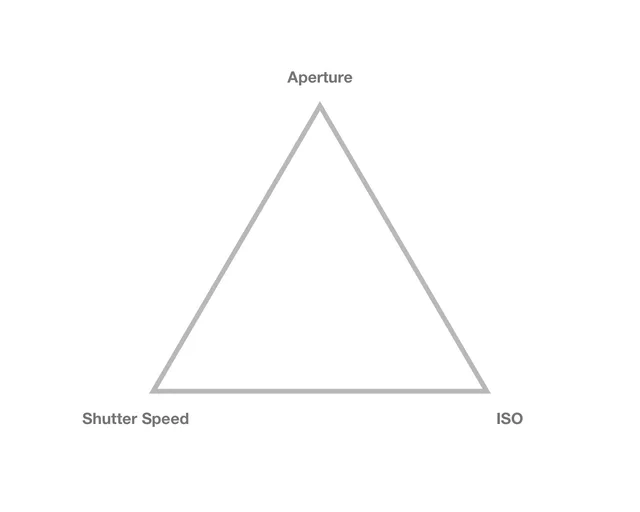
The Exposure Triangle illustrates the relationship between three aspects of a camera’s controls which together adjust the overall exposure of a photograph. These three variables are “shutter speed”, “aperture” and “ISO”.
Aperture
Aperture is probably the most important aspect of exposure to consider because it controls not just how much light can enter a lens, but it determines the depth of field. This means that careful consideration should be taken when selecting the appropriate aperture to shoot your subject matter.
“Depth of Field” is a term used to describe how much of an image is in focus. If your camera’s aperture is set to ƒ/2, the depth of field will be shallow—meaning only the items that have been focussed on will be sharp, while the rest of the what’s in the frame will be out of focus. If your camera’s aperture is set to the other extreme, say ƒ/32, everything in the frame will be in focus and the depth of field is considered to be deep.
The depth of the depth of field is determined by the relationship between the ƒ value and the distance between the camera and the subject. This is take to the extreme with macro photography and when shooting with telephoto lenses.
Aperture values are described as fractions and are written using the lowercase latin “ƒ”. Without getting into the technicalities, the easiest way to remember the relationship between the ƒ value and depth of field is this: The smaller the number, the shallower the depth of field.
Shutter Speed
The shutter speed is the length of time that a camera’s sensor or film is exposed to light. The longer the shutter speed, the more light is available for the exposure. Adjusting the shutter speed can lead to different qualities of movement in a photograph. If a photographer wants to stop fast-moving action such as sports, a quick shutter speed is preferred. Alternatively, if a photographer wants to smooth out any movement in an image, such as softening the movement of water over a waterfall, a slow shutter speed is preferred.
ISO (ASA)
ISO (or ASA in the US) is a measure of light sensitivity of the camera’s sensor or film where the higher the number, the more sensitive to light it is. A photographer would use a higher ISO when shooting in low light conditions such as an outdoor event at night time or an indoor event with nominal available light. The trade-off of using a higher ISO is the appearance of noise in digital cameras or grain in film cameras.